
Jacobs Entertainment's application for a massive sign along I-80 should be denied.
The proposed "Reno's Neon Line District" structure is an off-premises sign advertising one company's private interests, not a decorative sign identifying an area.

As usual, what I write here is my personal opinion, and all of the facts that I state therein are true to the best of my knowledge. That’s the legal disclaimer. I’m also frankly exasperated by all of this, which may be reflected in my tone. That’s the “I’m a real person not AI” disclaimer.
BRIEFLY: Jacobs Entertainment has submitted an application to erect a massive sign alongside I-80 advertising its trademarked “Reno’s Neon Line District.” It will not be reviewed in any public meeting but decided by City of Reno staff. I argue that it should be denied, for a whole plethora of technical, legal, and logical reasons.
The public can submit comments on this application until July 24 by writing directly to planner Leah Piccotti at PiccottiL@reno.gov referencing Case Number LDC26-00102: Reno’s Neon Line District Area Identification Structure. You can also submit comments via the City of Reno Development Services Comment and Review Form.
Why would you want to? I’ll explain my position, and you can decide for yourself.
As you may have heard, Jacobs Entertainment has applied to erect a massive sign along Interstate 80 that advertises their sprawling resort complex, which they have named “Reno’s Neon Line District” (more on the name below):
Jacobs Entertainment files pre-planning app for large freeway-visible sign for Reno Neon Line (Downtown Makeover 6/23/26)
Jacobs Entertainment moves ahead with sign along I-80, seeks approval for two skywalks (This is Reno 6/30/26)
The City’s notification is here and the complete application is below.

In it you’ll find this rendering of the proposed sign, which would stand 60 feet tall at 437 Stoker Avenue, on land owned by the Reno Lodge No. 13 Free and Accepted Masons d/b/a Masonic Memorial Gardens (APN 006-152-01). It would become visible to eastbound traffic just as downtown Reno comes into view and direct motorists to exit at Keystone and then turn on West 4th Street to reach this supposed “district.”
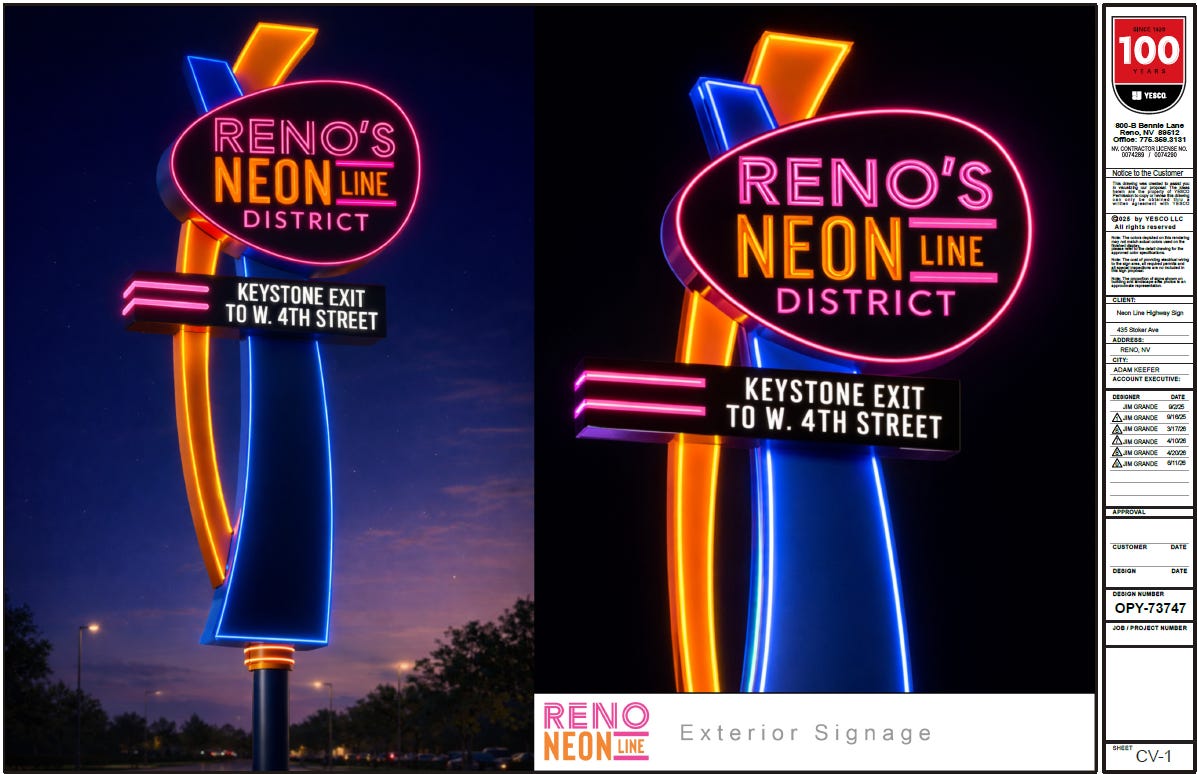
Because this sign is only subject to a “minor site plan review,” it will not be reviewed in a public meeting but decided by City staff on July 24th. Here’s a rendering of the proposed highway view as included in the company’s application.
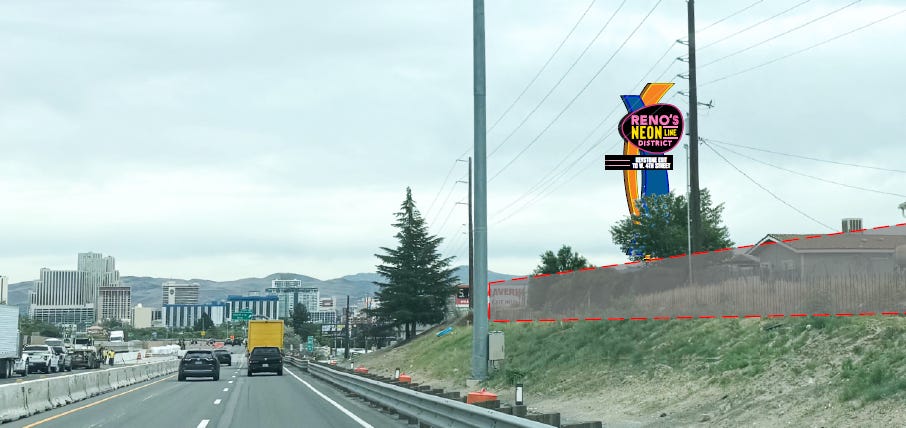
This proposed sign is a crown jewel amid the bounty of riches that the City of Reno bestowed upon Jacobs Entertainment in the bonkers Development Agreement that was approved nearly five years ago and required pretty much nothing of Jacobs—no housing, no shops, no street-level activation, no public spaces, no timelines.
I’ve written about that extensively, so feel free to revisit my many posts if you need to catch up. Here’s one I wrote right after Council’s approval of it in October of 2021.

Among the valuable perks given to Jacobs was the right to design the new programmable lighting just installed by RTC Washoe along West 4th Street, giving this private company an astonishing degree of control over public infrastructure.
Also in the Development Agreement, the City agreed to let the company install three signs that the City allowed to be categorized as “area identification signs.”
This categorization is critical, because thanks to Scenic Nevada, the City of Reno can no longer issue permits for the construction of new billboards (also called “off-premises advertising displays”). You can read more about the City’s prohibitions and regulations regarding billboards in Reno’s Land Development Code, Chapter 18.05, Article 2.
Of course, once Jacobs Entertainment came along and bought the Gold Dust West and Sands Regency and practically everything around them, they entered a competitive marketplace where Reno’s other major gaming and entertainment entities already had billboards along the highway that were grandfathered in and therefore allowed.
But get some promotional signage for it classified as a different kind of sign entirely, namely, “area identification signs,” and Jacobs could get some big signs of its own.
Here’s the city’s definition of an “area identification sign” (scroll down to “Signs” on this list of definitions):

Can these signs be used to identify a commercial complex? Apparently yes, when you are at them. Their purpose is to to IDENTIFY, not to promote, advertise, or direct.
An off-premises advertising display, in contrast, PROMOTES a commercial interest from afar and may provide directions for how to reach or contact the advertised entity.
When the City of Reno granted Jacobs Entertainment the right to erect three big signs advertising their resort complex in contradiction to the City’s own code, the nonprofit Scenic Nevada rightfully sued both Jacobs Entertainment and the City of Reno for mis-classifying these signs and paving the way for them to be erected.
And in 2023, Scenic Nevada partially won at the district level, when the district court judge prohibited two of the three proposed signs including the highway sign (known in the Development Agreement and in the case as the “cemetery sign” for its proposed location on cemetery grounds), determining that they were not “area identification signs” at all, and that the cemetery sign was, in fact, a billboard.
But the City of Reno (at the direction of City Council) appealed that decision, and in May 2025, the State Supreme Court ruled against Scenic Nevada, asserting basically that since these three proposed signs were not billboards according to the City, Scenic Nevada lacked legal standing to sue over them, and ruled that they were area identification signs, after all.
But here’s what the State Supreme Court wrote to defend that assertion:
“The plain language of these RMC provisions reveals that area identification signs and premises advertising displays have two distinct purposes: the principal purpose of an area identification sign is to identify an area of the community, while the principal purpose of an on-premises advertising display or a billboard is the promotion of a particular commercial interest” (page 6-7 of the ruling).
Exactly.
A highway sign promoting “Reno’s Neon Line District” is a billboard promoting a particular commercial interest because the phrase is a trademark (one of many related ones) registered by Jacobs Entertainment, a for-profit commercial entity.
Here’s the definition of a trademark from the U.S. Patent and Trademark Office:
“A trademark can be any word, phrase, symbol, design, or a combination of these things that identifies your goods or services. It’s how customers recognize you in the marketplace and distinguish you from your competitors.”
Here’s that trademark registration (click to search by owner).

The State Supreme Court’s decision said nothing about trademarks, but Jacobs’ trademarks for the “neon line” are incredibly pertinent.
When did this trademarking happen? In close association with the resort’s naming.
Jacobs Entertainment filed the trademark application for “Reno’s Neon Line District” on November 1, 2018.
The Development Agreement with the City was approved in October 2021.
The trademark for “Reno’s Neon Line District” was officially registered on November 29, 2022.
The trademark application for “J Resort’s Reno Neon Line” was filed on February 13, 2024 and is apparently “pending.”
In March of 2024, Jacobs Entertainment announced the new name of their entertainment complex: “J Resort’s Reno Neon Line,” while retaining the trademark for “Reno’s Neon Line District” (and a bunch of others).
By the city’s own definition, and in alignment with both the District Court and the Supreme Court definitions, the 60-foot “structure” that Jacobs Entertainment wants to erect on the side of Interstate 80 is not a “decorative sign used to identify” an area; it’s a promotional sign directing motorists to take the “Keystone Exit to W. 4th Street” to visit one company’s commercial interests located 3/4 of a mile away (and accordingly, directing them to NOT take one of the following exits, which would lead to its biggest competitors).
The name itself is a clever gimmick. If you want to convey the impression that the name of your private resort complex actually refers to a city-designated, city-authorized space, what do you do? Slap the name of your city at the front of it!
Note that it’s not the “Neon Line District,” or even the “Reno Neon Line District” (both of which the company actually filed to trademark and then abandoned)—it’s “Reno’s Neon Line District.” See what they did there with that little apostrophe? It implies ownership and endorsement, as though the entire city has objectively recognized and endorsed this as our city’s neon district and wants you to exit here.
IT HAS NOT.
J Resort’s “Reno’s Neon Line District” is not the place to view authentic neon in Reno (more on that below)—far from it. Moreover, the City of Reno has not given the area this name—not in the Development Agreement, not in the Master Plan, not anywhere.
The agreement itself describes the project it concerns as “A mixed-use entertainment district that the Master Developer is calling Reno’s Neon Line District in downtown Reno, Nevada” [emphasis mine]. The City planner presenting the agreement to City Council even said at the time, “I’m not aware that we’ve actually branded this the ‘Neon Line District.’” I wrote about all of this back in October of 2023.
The words “Neon Line” appear nowhere in the City’s Master Plan, unlike the terms “Midtown,” “Riverwalk District,” and “East 4th Street.” It is not one of the six “Downtown Districts” identified in the plan (“Entertainment District, University District, Innovation District, Riverwalk District, Northwest Quadrant, and Powning District”) nor in Title 18, the land development code.
Visit the website https://jresortsrenoneonline.org (below) and you’ll see the same logo style as the proposed highway adjacent sign and the full name of “Reno’s Neon Line District Presented by J Resort.” (You are also redirected to that webpage from the less corporate-sounding URL, https://www.renosneonlinedistrict.org/.)

And precisely what is being promoted on the webpage for “Reno’s Neon Line District Presented by J Resort”? Here’s the list:
J Resort (owned by Jacobs Entertainment)
Gold Dust West (owned by Jacobs Entertainment)
J Resort’s Festival Grounds (owned by Jacobs Entertainment)
J Resort’s Glow Plaza (owned by Jacobs Entertainment)
Glow Gardens (which doesn’t exist but if/when it opens, will be owned by Jacobs Entertainment)
Original Art (on Jacobs Entertainment property)
245 North Arlington, Gibson Apartments, and Renova Flats (one constructed and two renovated residential buildings, all owned by Jacobs Entertainment)
That’s it. Maybe they’ll soon add the Gold ‘N Silver, now that it’s reopened (and is also owned by Jacobs Entertainment). Click on “Contact Us” on the website and your email goes to jresortsrenoneonline@jresortreno.com.
And where is this supposed “district,” anyway? What are its boundaries? The website claims it refers to “West 4th Street and the surrounding area,” but you can’t brand a public street or someone else’s private property. So how can this be a designated “area” when it doesn’t even have a clear location?
So, to summarize: Did any other area property owner ask to be included in this “neon line district”? Nope. Does any other area property owner advertise themselves as being located in this “neon line district”? Nope. Does Jacobs advertise any other property as being located in this district? Nope. Does it matter? Apparently not!
It’s obvious that only one commercial interest is being promoted here.
So maybe you’re saying “Who cares?” “What harm does it do to let Jacobs Entertainment have this one big sign along the highway?”
The first victim is the City of Reno’s reputation. Yes, the City may have legally exercised its discretion in classifying Jacobs Entertainment’s promotional signs as “area identification signs” despite the fact that these signs would clearly promote a single commercial interest from a distance, serving not as “wayfinding” (“you are here!”) but as advertising (“come here!”). But it was inaccurate and unfair to do so.
What are some additional harmful repercussions? I can think of a few.
Setting a Precedent
If the City allows this sign to be categorized and installed as an “area identification sign,” it will not only subvert the intent of its own signage code but will set a dangerous precedent that could allow any private entity to skirt the legal prohibitions against new billboards by concocting fake “districts” comprised solely of their private holdings, trademarking their names, and asking the City of Reno to categorize far-flung signs advertising these private interests as “area identification signs” rather than as the (prohibited) off-premises advertising displays that they obviously are.
With such a precedent in place, the same pathway could be followed by any number of private entities, both existing and yet to be created—particularly those that are in the process of creating large, entirely private mixed-use developments, such as these:
The “Reno Experience District” (RED)
The Grand Sierra Resort
The proposed professional soccer stadium on Kietzke Lane
Downtown Damonte
And that’s not even counting other major property owners and private development projects like The ROW, the Reno Revival (former Harrah’s Reno), the development planned around Greater Nevada Field, and whoever else decides to follow their lead.
Blurring the line between the authentic and the fake
If the City wants to argue that this is an “area identification sign” then the City is endorsing its description of West 4th Street and some vague area surrounding it as “Reno’s Neon Line,” where visitors can witness the height of Reno neon. It is not.
I have repeatedly, as a historian, historic preservationist, and purveyor of truth, pointed out the hypocrisy of calling this private resort complex a “neon line” when the company singlehandedly destroyed multiple motels brandishing historic neon signs and has lined its properties with not neon lighting but LED. Do they include some authentic neon? Sure. But most of that actual neon is on replica signs, not originals.
And that matters because neon is not just a color but an actual element—it is, in fact, Nevada’s official state element. It is endangered, it is precious, it is unique.
It matters because despite Jacobs Entertainment’s campaign of destruction, Reno still has plenty of authentic neon throughout the city. And if people are looking for the highest concentration of authentic neon signage in the city of Reno, neon preservationist and restorer Will Durham is about to open his Light Circus, a stunning collection of authentic neon signs from across Reno and Nevada, inside the National Bowling Stadium—on the other side of downtown from Jacobs’ complex.
In naming its resort complex “Reno’s Neon Line District,” Jacobs Entertainment aims to profit from collective nostalgia for something whose historic context they have methodically destroyed. And in doing so, they not only imperil the recognition and preservation of authentic neon but diminish its value by blurring the distinction between the real and the fake. It’s even worse that agencies and institutions from the City of Reno to RTC Washoe to Visit Reno-Tahoe are helping them do so.
Unanticipated consequences of redirecting traffic to West 4th Street
Jeff Jacobs has directly stated his intent to make West 4th Street, where his two casino properties are located, the new vehicular entrance to downtown Reno. And through their recent actions, the City of Reno and RTC Washoe appear to be endorsing this plan even though there was no public decision directing them to.
It’s not a coincidence that the proposed erection of this sign follows closely on the heels of the completion of J Resort’s new 4th Street-facing vehicular entrance and the installation of RTC Washoe’s out-of-scale streetlights. In the Jacobs era, West Fourth Street has not become a walkable mixed-use district; it’s become a driveway.
Meanwhile, Virginia Street continues to struggle from lack of vitality and visitation. What would happen if this sign successfully convinced travelers to exit at Keystone to reach what they are led to believe is the heart of Reno’s tourist district, based on its misleading language? Does the City have any idea? Does the RTC? Does NDOT?
(And speaking of NDOT, don’t they have their own regulations of billboards?)
Any other downtown business, along with any Reno business or entity featuring authentic neon or any commercial interest that isn’t being allowed to erect an off-premises advertising display would certainly seem to be an aggrieved party here (with standing to appeal the decision, should the City approve this application).
It all comes down to findings.
Approval of this application rests on the staff’s ability to make the required findings. You can read the application for the company’s responses to all of these. Keep in mind that the “proposed land use” or project here is just the sign, not the resort complex.
Is the proposed land use and project design compatible with surrounding development (cemetery, street, neighborhood, interstate)?
Is the proposed land use and project design consistent with applicable development standards (like the actual definition of area identification signs)?
Are public services and facilities available to serve the project, or will be provided with development (probably N/A—it’s a sign)?
Are the characteristics of the use as proposed and as may be conditioned reasonably compatible with the types of use permitted in the surrounding area (new billboards are not permitted in the City of Reno)?
Will the granting of the minor site plan review be materially detrimental to the public health, safety, or welfare?
The sign also must be consistent with the Reno Master Plan, in compliance with Title 18, and mitigate any anticipated traffic impacts. I find it to be inconsistent with the first two and to fail to do the latter, as stated above.
Those are my thoughts. If you have your own concerns, PLEASE send them to the City ASAP using the links up top. The decision date is July 24th. Take care, all.
Be sure to check out my Citizen Guide for helpful resources and links to help anyone become more informed and engaged in issues related to urban development (& more) in Reno.
You can view this and prior newsletters on my Substack site, subscribe to receive each new edition in your email inbox, and follow the Brief (and contribute to the ongoing conversation) on X, Facebook & Instagram. If you feel inspired to contribute, you may purchase a paid subscription through Substack or contribute via Venmo at @Dr-Alicia-Barber, via the Buy me a coffee platform, or via check to Alicia Barber at P.O. Box 11955, Reno, NV 89510. Thank you!
I find this extremely interesting. Those signs must consume massive amounts of electricity. They may result in revenues. But, isn't this the same planning commission and city council that wants to put the authorization of new (job producing) data centers on hold because they, allegedly, consume too much of our electricity? What about benefit to the prosperity of the WHOLE community?
Once someone typed “area identification” into the right box, the public hearing question was basically dead. Forms are often a feature, not a bug. Same sign, different label, less pesky public debate getting in the way. Administrative sorcery at its finest.